Athletes are often taught to train hard, push limits, and sacrifice anything to achieve goals. It is easy to become consumed by the constant drive to be the best. Therefore, the intense focus on athletic performance can overshadow an equally important aspect of being an athlete: balance. Without balance, athletes’ mentality and performance will crumble. Here are some tips on maintaining balance in my daily routine, which I hope will be helpful to you if you’re an athlete too.
Tip 1: Take time to recover
While it may seem easier to skip cooling down or stretching after a workout, it is extremely necessary. Despite all the other tasks you may have in your day, taking time to let the body rest and regenerate is crucial for improvement in any sport and helps prevent injury. After practice, I make sure I visit the training room to either roll out, do compression boots, or ice bath. Especially if I had a hard workout that day. Training without recovery does not lead to success, and no athlete can expect to improve without proper recovery.
Tip 2: Have a calendar
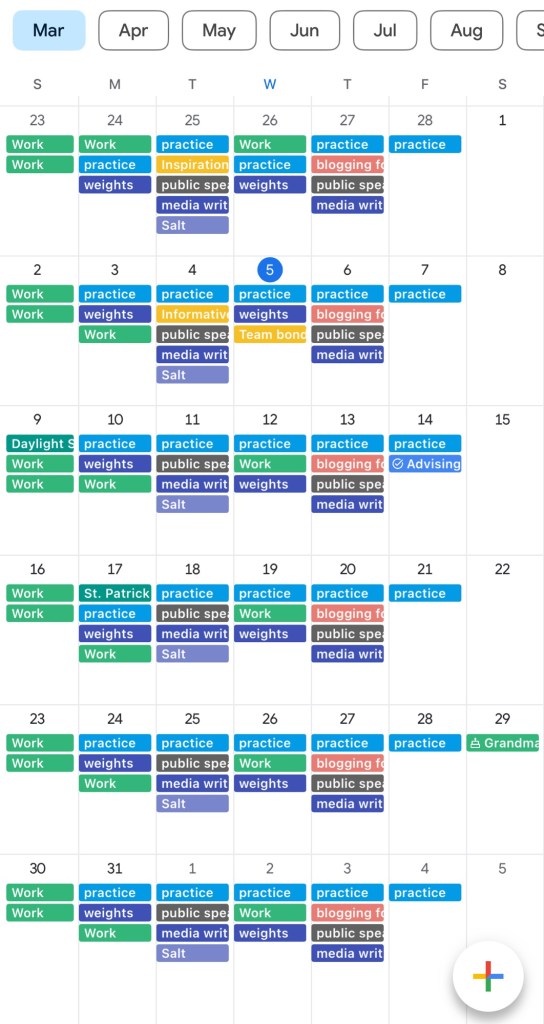
Student-athletes have incredibly packed schedules. I was always busy in high school, but I never fully realized how much more hectic things would become once I got to college. I practice 2 to 3 and a half hours a day, have class, and work 15 to 20 hours a week. On top of all that, I had much more homework than I ever did in high school. There were multiple instances at the beginning of the year when I had forgotten about an athletic obligation and forgot to request the day off work or an assignment due and mixed up the day it was due because I didn’t write it down. Having a calendar to organize all my events not only keeps me on top of my responsibilities but also helps me manage stress and anxiety. When there’s always so much to do, the mind can easily become overwhelmed. Some form of organization is always beneficial.
Tip 3: Set boundaries for athletic and personal life
There were moments in high school when I became so focused on training that I overlooked other aspects and people in my life. Although I believed I was making the right decision by prioritizing my training, I ended up feeling overwhelmed and lonely without the important time spent with my friends and family. Since coming to college, I have learned that spending time away from track is just as important as the training. Although boundaries may seem strict, there are ways to establish healthy ones. Engaging in other activities allows you to disconnect from the pressures of your sport and maintain a more healthy relationship with training.
Finding balance as an athlete doesn’t necessarily mean doing less. Understanding that training, mental health, and personal fulfillment all contribute to a balanced life is essential for everyone—whether you’re an athlete or not.
Embrace rest, nurture your well-being, and make space for personal interests.
 The Unspoken Athlete