Author: Savanna Amack

  • Changing Dynamics

    Based on the topics discussed in this week’s blogs, these are, in my opinion, the most effective calls to action for changing the dynamics between men’s and women’s sports. 

    1. Equal Coverage and Representation

    One of the most impactful ways to change the dynamics is to push for more media coverage of women’s sports. The media plays a crucial role in shaping public perceptions, and when women’s sports receive the same attention as men’s, it will boosts visibility. Increased visibility could in turn attracts sponsorships for female athletes and encourages young girls to participate in sports.

    2. Support Women’s Sports Organizations

    Investing in and supporting women’s sports organizations like the WNBA or foundations like the Women’s Sports Foundation helps to create sustainable growth for female athletes. Whether it’s attending games, buying merchandise, or spreading awareness about their achievements, fans can directly influence the growth and success of women’s leagues.  

    3. Encourage Young Girls to Participate in Sports 


    If I didn’t have the opportunity to play sports in school, I would have never pursued the passion in college. This fact is true for many pro female athletes and olympians. Providing access to athletic programs and promoting school sports teams early in school are two easy steps to take towards this goal. Coaches, parents, and educators can play a crucial role in helping young girls Ωunlock their full potential and change gender dynamics in college and pro sports. 
  • Too Ghetto

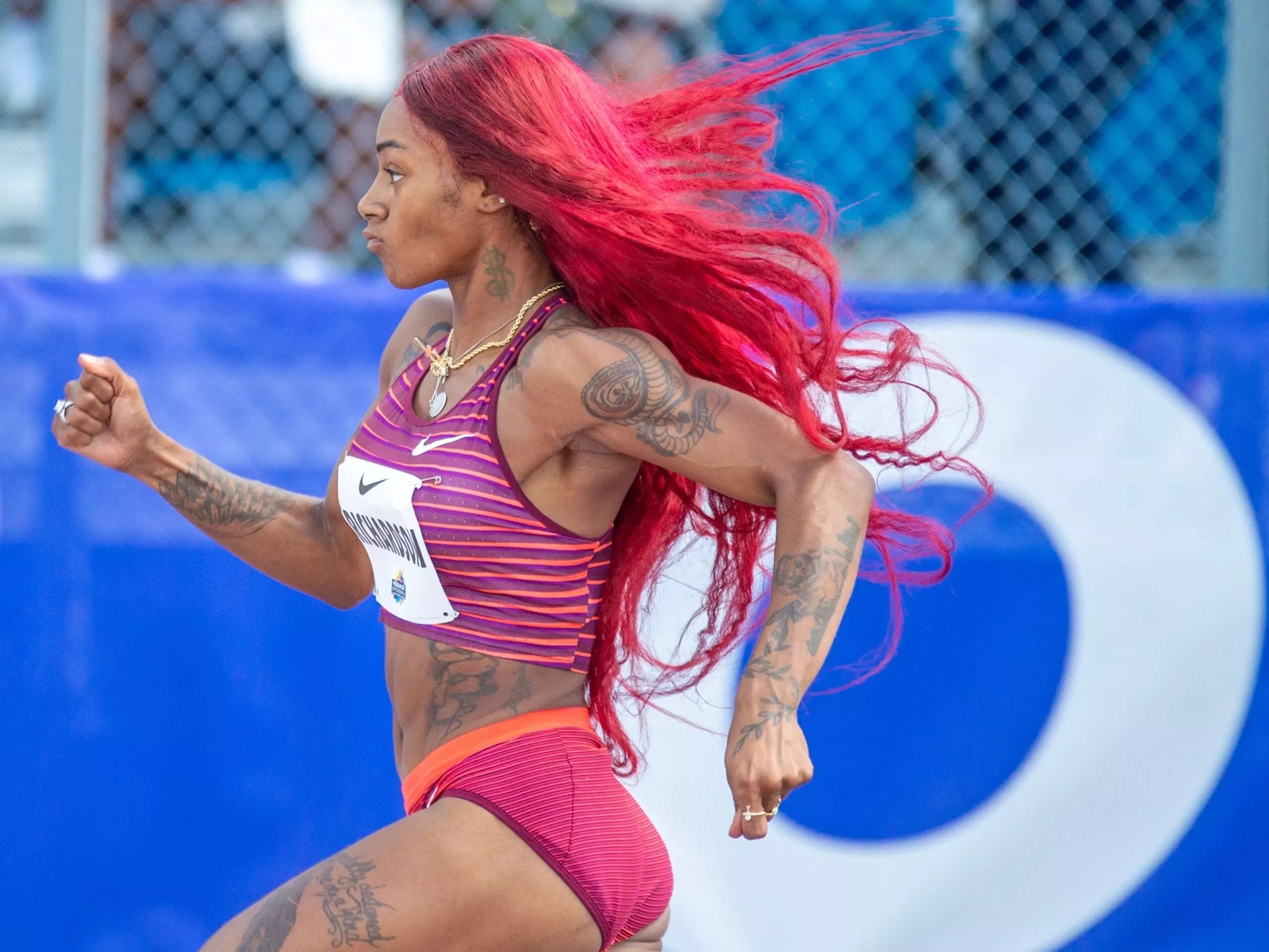
    In 2021, Sha’Carri Richardson was the female track athlete to watch. Beyond her immense athletic ability, Richardson has a very different way she expresses herself in the public eye. With her colorful wigs, long nails, and bold personality, Richardson quickly stood out as someone who wasn’t afraid to break from the norm. However, instead of being celebrated for her individuality, she faced harsh criticism. Many people labeled her as ‘ghetto’ or ‘too much,’ trying to reduce her to a stereotype because of her unapologetic and confident demeanor.

    These reactions highlighted the societal discomfort with women, particularly Black women, who embrace their full selves without conforming to traditional expectations. Despite the criticism, Richardson remained unfazed and continued to express herself authentically, using her platform to encourage others to embrace their uniqueness. In 2024, Sha’Carri won Gold and Silver at the Paris Olympics. Through her resilience, she not only redefined what it means to be a track and field athlete but also challenged the norms surrounding beauty, femininity, and strength in sports. 

    Sha’Carri Richardson resonates with me not just as an athlete or a woman, but because she fearlessly embraces her true self in a world where women have long been confined to certain stereotypes. She stands as a powerful example to new generations of female athletes, showing them they should never be ashamed of who they are.

  • Breaking Barriers

    With the highly anticipated March Madness tournament underway, I wanted to explore various topics this week related to women in sports. Sports have traditionally been male-dominated, and despite progress, women still fsce disparates in hig profile athletic events.

    In addition to track and field, I played basketball throughout middle and high school. From the time I was in 7th grade, Paige Bueckers became my favorite player to watch. I remember discussing Bueckers’ commitment to the University of Connecticut with classmates who had no idea who she was. Before Caitlin Clark’s rise and the surge in popularity of women’s college basketball in 2021 and 2022, the Women’s NCAA Tournament often flew under the radar. Hardly anyone was discussing it, making brackets, or placing bets on the games. Fast forward to my junior year of high school, and Caitlin Clark had become the new sensation with her game-winning shots and deep three-pointers. Suddenly, people at my school were talking about women’s basketball.

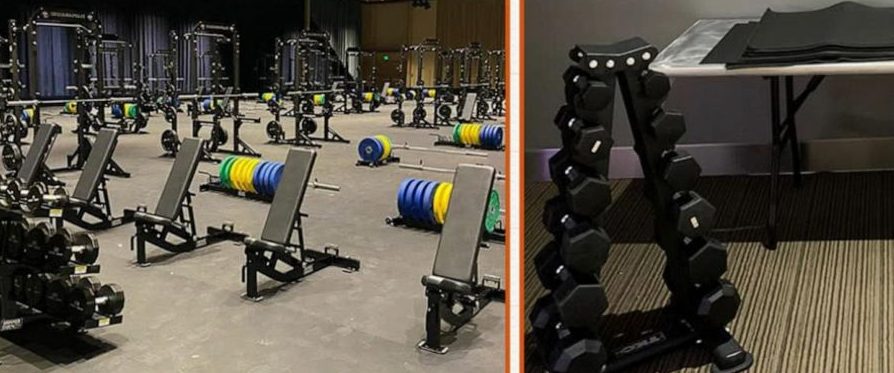
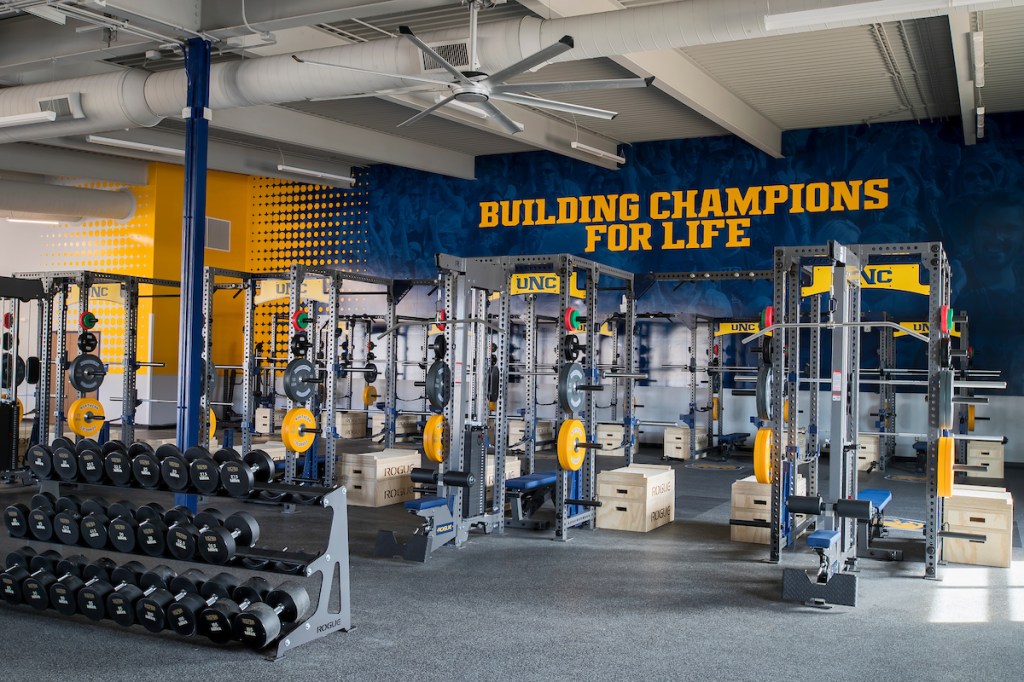
    As the popularity of women’s sports grew, so did the conversation about the disparities between male and female college athletics. In 2021, the stark differences in facilities for the men’s and women’s teams sparked public outcry. While the men had access to top-tier resources, the women were left with far less. I remember scrolling through TikTok and seeing videos from women athletes during March Madness, showcasing the stark differences in their experiences. While the women had just a single rack of dumbbells as their “weightroom,” the men had entire racks and sets of equipment. The women received only water bottles and basic t-shirts for making it to the tournament, while the men were given toiletries, blankets, hats, and more. I was so invested in the issue when it was brought to light, especially after reading that the NCAA had released a statement claiming the disparity wasn’t due to money, but space. None of it made sense to me—viewership of the games doesn’t correlate with the level of amenities provided during the tournament. 

    While audience numbers are a huge component to funding, the media often gives more attention to the men’s tournament, leaving the women’s game with less coverage. Many women’s basketball players also face challenges in securing the same endorsement deals or professional opportunities as their male counterparts. For example, despite standout performances, athletes like Sabrina Ionescu and Caitlin Clark have had to work harder to gain sponsorships that are more easily accessible to male athletes. However, advocacy for increased visibility and equality is making a difference. Organizations like the Women’s Sports Foundation and initiatives such as the NCAA’s commitment to expanding women’s sports coverage are pushing for change. Witht he help of these organizations, female athletes are aided in their advocacy for equal media coverage, sponsorship opportunities, and pay. 

    I remember in high school, the argument for why men earned more was that more people wanted to watch men’s sports over women’s. While there’s some truth to that, it’s short-sighted to ignore the fact that we have the power to push women’s games into prime viewing hours on TV and promote them just as much as we do men’s sports. 

    The fight for equality in sports is far from over. When issues are openly discussed, people take notice and disparities begin to be resolved. 

  • Progress

    Like any sport, track comes with a demanding training schedule and some incredibly tough practice days. I’m talking about those days when you’re rolling on the ground, feeling like you can’t even walk afterward. I came from a high school with a track team that wasn’t very serious, so when I got to college, I was shocked by how intense the practices during fall training were. 

    The first week of practice is usually pretty laid-back. Teams typically meet with their coach to go over the training schedule and maybe do a couple of light workouts. Not the jumps group. Right from the start, during that first week in September, we were already hitting hills, stadiums, and extensive circuits. 

    While the workouts didn’t sound too bad in theory, my body was so out of shape that I was seeing stars through every single one, no matter how intense. Thankfully, I wasn’t alone—my teammates were right there with me, feeling the pain too. In high school, I didn’t have teammates to train with, so I did everything alone. I’m grateful for my teammates now, not just because I don’t have to face the tough times by myself, but because we can grow together.

    Looking back, I can say that since September, I’ve made huge progress as an athlete. The tough workouts are more manageable now, and I’ve learned that my limits aren’t limits at all. I can always push beyond them.

    So, if you’re a college freshman feeling like you won’t make it through the hard days, just remember: those tough days are the ones shaping you into the best athlete you can become.

  • Outdoor!

    The outdoor season of track is finally here, and it’s the perfect time to take a fresh approach to mental health. 

     I can’t speak for every track athlete out there, but going into the outdoor season this year has been tough. Since the indoor season did not go as I hoped, it’s been hard to be mentally checked in for going outdoors. For me, it’s hard to enjoy a sport if I’m not excelling. I’ve spent a lot of time reflecting on my performances and feeling frustrated with where I’m at. That pressure to do better and the comparison to others can make it hard to stay positive.

    At times when I feel helpless, I try to remind myself of why I love the sport in the first place. The milestones I’ve overcome, the high from accomplishments, and the people I’ve met are the reasons I keep going. It’s not just about crossing the finish line first or setting a personal best—there’s a deeper connection to the sport that keeps me pushing forward, even when the results aren’t what I expected.

    By reconnecting with the reason you love your sport, I believe you can preserve your mental health while chasing goals. It’s essential to not let the pressure of expectations steal the fun from your season. Track and field, like any sport, is meant to be enjoyed and cherished, and it’s okay to take a step back and focus on the process rather than just the outcomes.

    Remember, taking care of your mind is just as essential as strengthening your body. It’s about finding balance, embracing the ups and downs, and celebrating the small wins along the way. Keep showing up, trust the journey, and never forget why you started in the first place.

     It’s the passion that keeps you going when the road gets tough.

  • The Mental Game: A Conversation with Alison Hoodak 

    Being a student-athlete comes with a unique set of challenges. Balancing academics, training, performance pressure, and the occasional injury are all aspects of college athletics. For Alison Hoodak, a freshman on the University of Nothern Colorado Track Team, the experience is rewarding and demanding. 

    I had the chance to talk with Hoodak about her journey in college athletics so far. She provides a fresh perspective on the physical and mental challenges of sports and shares a unique story about the student-athlete experience. Hoodak is a sprinter and runs the 60, 100, 200, and 400-meter dash as well as various relays. 

    Being a student-athlete comes with expectations on and off the track. With the added visibility that comes with the athlete role, maintaining a positive image is almost second nature. 

    “We’re held to a higher standard, especially in public settings because there are more eyes on us,” Hoodak said. 

    College athletics isn’t just about competing well, it’s about representing their school, team, and the sport they play. Responsibility comes with its own set of pressures. Stress is an inevitable part of the experience. 

    Every athlete experiences anxiety and performance pressures differently. For some, it’s easier to maintain composure in a relaxed and focused setting such as practice. Conversely, Hoodak finds it easier to manage nerves during competition than when she’s training. 

    “When I’m competing, I’m a lot better at managing my mentality and not freaking out. If I’m having a bad day at practice, it’s a lot harder to keep myself in a positive headspace,” Hoodak said. 

    One of the toughest battles an athlete can face is injury. Trine University published an article titled “Mentally Overcoming Injuries” stating that when an injury occurs, athletes who have not developed a healthy coping mechanism to deal with failure may feel like they failed themselves. This past indoor season, Hoodak experienced a hamstring injury that prevented her from competing in the first half of the season. 

    “It was a battle to even show up every day since I was doing such easy rehab exercises instead of running and training. It felt like I wasn’t improving at all,” Hoodak said. 

    Hoodak said she has always been used to pushing her limits, so adjusting to the slower pace of recovery was a process for her. Despite the hardship that injury brings, Hoodak reminds herself that progress isn’t always going to look the same. 

    “Even if it doesn’t feel like I’m doing anything, I know I’m improving in some way. I might not be getting faster right now, but I’m getting stronger from when I first got injured,” Hoodak said. 

    Coming back from injury is as much a mental challenge as a physical one. The process can be frustrating, and athletes often don’t have a perfect answer for the stress and anxiety that come with it. What matters is showing up, trusting the journey, and recognizing that every step forward, no matter how small, is still progress. 

  • Finding Balance

    Athletes are often taught to train hard, push limits, and sacrifice anything to achieve goals. It is easy to become consumed by the constant drive to be the best. Therefore, the intense focus on athletic performance can overshadow an equally important aspect of being an athlete: balance. Without balance, athletes’ mentality and performance will crumble. Here are some tips on maintaining balance in my daily routine, which I hope will be helpful to you if you’re an athlete too. 

    Tip 1: Take time to recover

    While it may seem easier to skip cooling down or stretching after a workout, it is extremely necessary. Despite all the other tasks you may have in your day, taking time to let the body rest and regenerate is crucial for improvement in any sport and helps prevent injury. After practice, I make sure I visit the training room to either roll out, do compression boots, or ice bath. Especially if I had a hard workout that day. Training without recovery does not lead to success, and no athlete can expect to improve without proper recovery. 

    Tip 2: Have a calendar

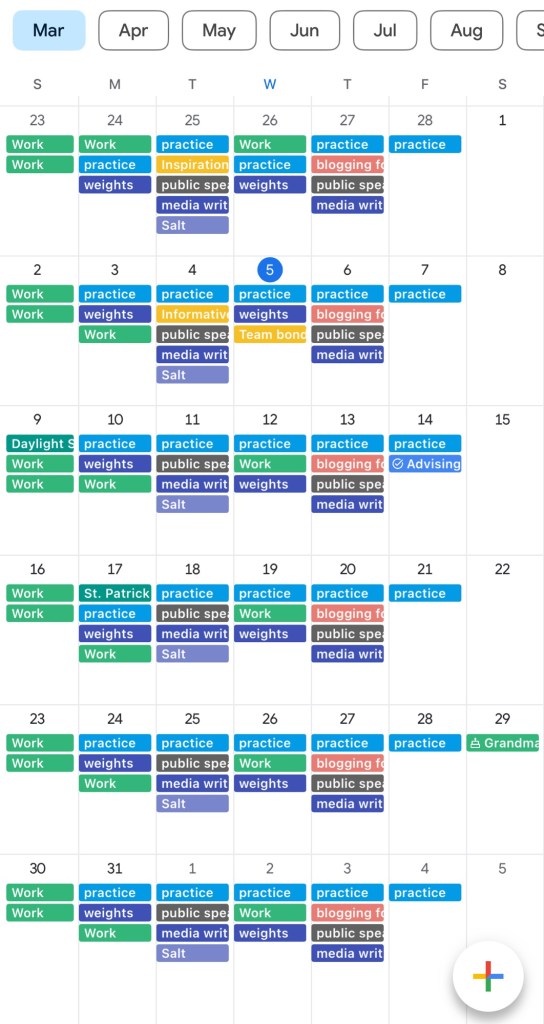
    Student-athletes have incredibly packed schedules. I was always busy in high school, but I never fully realized how much more hectic things would become once I got to college. I practice 2 to 3 and a half hours a day, have class, and work 15 to 20 hours a week. On top of all that, I had much more homework than I ever did in high school. There were multiple instances at the beginning of the year when I had forgotten about an athletic obligation and forgot to request the day off work or an assignment due and mixed up the day it was due because I didn’t write it down. Having a calendar to organize all my events not only keeps me on top of my responsibilities but also helps me manage stress and anxiety. When there’s always so much to do, the mind can easily become overwhelmed. Some form of organization is always beneficial. 

    img_0704-1

    Tip 3: Set boundaries for athletic and personal life 

    There were moments in high school when I became so focused on training that I overlooked other aspects and people in my life. Although I believed I was making the right decision by prioritizing my training, I ended up feeling overwhelmed and lonely without the important time spent with my friends and family. Since coming to college, I have learned that spending time away from track is just as important as the training. Although boundaries may seem strict, there are ways to establish healthy ones. Engaging in other activities allows you to disconnect from the pressures of your sport and maintain a more healthy relationship with training.  

    Finding balance as an athlete doesn’t necessarily mean doing less. Understanding that training, mental health, and personal fulfillment all contribute to a balanced life is essential for everyone—whether you’re an athlete or not. 

    Embrace rest, nurture your well-being, and make space for personal interests.

  • Goal-Setting

    Setting goals is one of the most powerful tools an athlete uses to stay focused and motivated in their sport. Goals not only push athletes to become better, but they also provide direction, motivation, and a sense of purpose in their training and overall journey. 

    The most effective goal-setting method that has helped me is using SMART goals. SMART goals are goals that are specific, measurable, achievable, realistic, and timely. The smart goal approach has allowed me to set clear and untenable goals and has helped me refrain from holding myself to unnecessarily high expectations. 

    The SMART goals I usually set are short-term to keep me motivated on a day-to-day basis. I have long-term goals too, but I find I improve the most when I focus on little things happening at the current moment. 

    Revisiting and adjusting goals over time ensures that athletes continue to challenge themselves. When setbacks occur, having clear goals can serve as a reminder of the bigger picture. Doing so ultimately makes it easier for athletes to stay motivated and bounce back from challenges. 

    Goals help athletes reach new potential because once a goal is met, a new bigger goal can be set.

  • Self-Care

    Achieving your full potential as an athlete involves making small adjustments in your daily routine. Eating nutritious foods, stretching outside of practice, and getting a full night’s sleep are all essential components of being a great athlete. 

    College is way different than high school, and a lot of athletes cannot keep the same bad eating and sleeping habits and still perform well. Not only did making little adjustments help my energy during practice, it helped my motivation throughout the day with classes. 

    First semester, I had classes in the morning and practice at 3 in the afternoon. I would go to sleep between 12 and 1 a.m. and would eat very little or very unhealthy during the day. By the time practice came, I was extremely groggy. 

    This semester, I have practice in the morning at 9 and classes later in the day. Because practice is early, I felt I had a new discipline. I wanted to go to bed early and eat a good breakfast before practice because I wanted to make sure I had a quality training session. Being productive early in the day motivated me to do the same for classes and homework. 

    The reality is that I should have had that discipline first semester even if I had classes in the morning instead of practice. Taking care of yourself enhances various aspects of your life, not just your athletic life.  

    Beyond improving performance, athletes should adopt healthier habits for the sake of overall well-being.

  • Meet Day

    If you’re an athlete, you know the day of a game, match, or meet can be exhilarating, exhausting, and maybe a little chaotic. For track athletes, meet days are full-day events, requiring extra preparation. A successful day goes beyond just what you pack; it’s about ensuring both your mind and body are in peak condition. 

    Feeling great on meet day is doing great on a meet day. This is how I keep myself mentally ready for competition.

    The first step I take is playing music when I’m getting ready. I find keeping a consistent routine in and out of competition is the best way to keep my mind relaxed. Music helps me wake up and set a positive tone for the day, so I foster it into my meet days. 

    After I’m ready and everything is packed I make sure to eat a breakfast that will provide me with sustained energy for the day. Greek yogurt with granola and cottage cheese is my go-to.

    The entire ride to the meet, I mentally prepare myself. I take time to visualize my jumps and how I’m going to execute them. I’m always a bit nervous on meet days, so once we arrive I usually try to find a quiet space where I can sit, stretch, and do breathing exercises. Stretching right away helps get the body moving and warm especially after a long bus ride. 

    When it’s time to start warming up, I put on R&B music to relax before my event. Warm-up takes about an hour and a half and is essential for injury prevention. Before check-in, I take my headphones off and always pray. 

    Showtime.